Thursday, April 3, 2014

Cookie Cutter Brains - The New Disease of Creativity

 
Just this morning, an Army specialist, under psychiatric care for post traumatic stress syndrome (PTSD) and anxiety, inexplicably decided to open fire and killed four people, including himself, and injured sixteen others at the military base at Fort Hood in Texas.  In 2009, a former Army major and psychiatrist also opened fire in Fort Hood killing thirteen people and injuring 30.  It was the worst mass murder on any American military base in history. 

This time, newscasters scramble to answer the questions of "Why" or "How can we prevent this in the future by better diagnosing the mental health of potential killers?" 

If you want to learn about mental health, then study the military.  Our modern classification system for mental health disorders has much of its early history rooted in trying to diagnose our military men and women.  In 1952, after a major shift in psychiatric focus to large-scale Army and Navy focus on diagnosing and treating various psychiatric disorders among military men after World War II, the American Psychiatric Association (APA) published its first manual of standard classification of mental disorders.  It was called The Diagnostic and Statistical Manual of Mental Disorders (DSM) and since that time has been updated periodically every 15-20 years to incorporate new developments in mental health concepts.  For example, in the 1974 version finally got rid of its classification of homosexuality as a mental disorder.  By 1994, the Clinton Administration initiated the "Don't Ask Don't Tell" policy regarding the admission of gays and lesbians into the military.

Last year, the APA published its fifth edition - the DSM-V.  The new edition changed several codifications and requirements including removing the A2 criterion for PTSD  because its requirement for specific emotional reactions to trauma did not apply to combat veterans and first responders with PTSD.  Maybe this will help us label the most recent Fort Hood killer, an Iraq War veteran, as having suffered from PTSD - in which case, maybe special future restrictions will be set up to control all people diagnosed with PTSD.

Clearly, when you want to change public policy, it is most helpful to change classifications for mental health disorders.  In the last fifty years, the DSM has increased the number of mental illnesses from 130 to a whopping 357!  Does that mean we are becoming a sicker society or that psychiatrists are finding more ways to label us as "sick"?  Things that used to be "personality traits" are now being characterized as "disorders" and "diseases."

What if we wanted to change our society?  What if you wanted to create a society of passive citizens who agreed with whatever policy you dictated to them?  Just create a new type of mental illness!  You could create a psychiatric label for all those people who don't like authority and have their own ideas about society and justice.  Then, bingo!  No more dissention.

Not surprisingly, the new DSM-V does exactly this.  It identifies a brand new mental illness called "oppositional defiant disorder" or "ODD."  It is defined as "an ongoing pattern of disobedient, hostile and defiant behavior" and its symptoms include questioning authority, negativity, defiance, argumentativeness and being easily annoyed.  This new "illness" defines people who suffer from ODD as being arrogant, narcissistic, cynical, having anti-social behavior and - get this! - having above-average creativity!!!

Not only does this have terrible implications for a potential fascist or Stalinist type of political repression of a nation (just lock them up in psychiatric institutions if they have "creative" or "oppositional" political ideals that conflict with yours!), but it also has terrible implications for my line of work. 

As I have noted many times in my work on psychic applications, in order to do this type of work at all, you must process your thoughts differently.  It involves "above average creativity" and may also involve a certain degree of "arrogance" or "narcissism" in order to achieve a high degree of trust in one's own very unconventional and often unverifiable perceptions and observations.  Will all psychics now be labeled as "ODD"?  Will our government at some point be able to lock up all creative thinkers, like psychics, artists and intellectuals, on the pretext that they suffer from a mental disorder? 

Whether you believe in New World Order conspiracy theory or are just a historian of fascist regimes, the APA's new DSM-V classification of creativity as a disorder is downright frightening!


Sunday, March 2, 2014

The Crime of Crimea

(Mustafa Abdülcemil Qırımoğlu (Mustafa Jemilev), former Presidential Representative of Crimea)

A few years ago I was invited to a party, given by an Egyptian socialite, at her apartment in New York City.  It was winter and fairly cold outside.  As I entered the apartment building and walked through the enormous lobby, I saw a tiny sober-looking man seated on a bench, flanked by two other unusual-looking men.  He wore a buttoned-up overcoat and faintly Russian-looking tall lambs wool hat.  He appeared to be watching all the people enter the lobby with an intensely sad expression on his thin, drawn greyish face. 

I had a hunch that he was going to the same party as us. And indeed he was.  He showed up a few minutes after us in the crowded apartment filled with loud, laughing, champagne-drinking actors, opera singers, business people, and lawyers.  It was a very multicultural gathering.  He seemed oddly out of place.

Mustafa Jemilev, also known as Mustafa Abdülcemil Qırımoğlu, was the guest of honor at my friend's party.  He was the equivalent of the President of Crimea, although Crimea, due to its long and confusing history, doesn't technically have its own president, but because of its strange status as an independent state of the Ukraine, Crimea sends its "presidential representative" to the Ukrainian Parliament.  Mr. Jemilev, a well recognized leader of the Crimean Tatar National Movement, has fought all of his life to bring his people, a Turkic mostly Muslim ethnic group who are fierce descendants of Genghis Khan who speak Crimean Tatar, Russian or Turkish, back to their homeland in Crimea. 

Our Egyptian hostess finally clapped her hands to get our rowdy attention, and she introduced her guest, Mr. Jemilev.  He sat quietly on the sofa still flanked by the other two men. (Later I spoke with the other two men and learned they were two of the most powerful businessmen in the Ukraine). Mr. Jemilev began to speak.  His English was awful - almost incomprehensible.  But slowly I began to understand the history of a tiny strategic country sandwiched on a peninsula in the Black Sea, like a dangling uvula at the back of a gaping mouth, between Russia and Ukraine.  It also became clear why he was so physically frail and sad.

I knew nothing about the history of Crimea or its people.  Only that its naval bases were strategic to Russia.

In 1783, Russia violated its treaty and invaded Crimea.  After this annexation, the Russian czars engaged in a policy of massacring and exiling hundreds of thousands of Crimean Tatars.  Two-thirds of the Crimean Tatar population either perished or was forced out of the country.  During Stalin's reign, many of the remaining Crimean Tatars who were attempting to establish the first democratic republic in the Islamic world, were brutally suppressed, imprisoned or executed.  Soviet policies resulting in widespread starvation in 1921 and more than 100,000 Tatars starved to death and others fled to Turkey or Romania.  Ten years later, there was another Soviet-led mass starvation of Crimea.  The amazing reality was that between 1917 and 1933, half of the Crimean population had been either killed or deported.

Mr. Jemilev's people were again subjected to Soviet attack when, in 1944, accused of aiding Hitler's campaign,  all Crimean Tatars were deported en masse as a form of collective punishment and were permanently exiled to Uzbekistan.  Half the entire population died of disease or malnutrition.  Mr. Jemilev was only six months old when his family was deported that year along with the rest of the entire Crimean Tatar population.  He grew up in exile in Uzbekistan.  At a young age, he became active in a political group of young Crimean Tatars who sought the right to return to their homeland.  For his efforts, he was rewarded by the Soviet government, between 1966 and 1986, by being arrested six times, served time in Soviet prisons and labor camps, and lived under constant surveillance.  He went on the longest hunger strike in the history of all human rights movements.  His hunger strike lasted for 303 days - almost an entire year - but he survived due to force feeding. 

In 1989, he was elected to head the newly created Crimean Tatar National Movement and his people were finally allowed to return to Crimea.  Roughly 250,000 Tatars returned to Crimea while another roughly 100,000 still remain relocated in other countries.  Following the collapse of the Soviet Union, in 1992, Crimea was granted independence and briefly elected its own president, until it was again suppressed, this time by its new "owners" - the Ukraine.  Mr. Jemilev has been reelected to the Ukrainian parliament almost continuously since 2002.

As of this writing, Russia has decided to covertly invade Crimea - again - as a reaction to the unrest and anti-Russian political upheaval in Ukraine. 

This morning I watched the television pundits speculate on what Russia will do: Reabsorb Crimea into Russia to protect its naval interests?  Use Crimea as a bargaining chip to obtain political leverage in Ukraine?  Use Crimea as the launching pad for an all-out military invasion of Ukraine?  No one seems to have a strong grip on the unfolding events. The West seems strangely conflicted - like a mother who has caught her child with his hand in the cookie jar for the third time, threatens to send him to his room, but ultimately does nothing.

I believe Russia had no other option than to invade Crimea.  It cannot afford to lose that strategic advantage and the Black Sea Fleet.  I don't believe Russian President Putin ultimately intends to invade Ukraine the way it did to the newly-reforming Republic of Czechoslovakia in 1968.  I still remember seeing the TV images of the tanks rolling into Prague and being shocked by the sheer audacity of the Russian military.  However, I don't believe the so-called "Brezhnev Doctrine," upon which the Russians have historically relied to invade any country whose political developments threaten communism, can or will be used to justify a similar invasion in the Ukraine.  After all, why bother?  The Russians have had covert governmental control over that country for decades anyway and have the support of nearly half the population. 

But Crimea is a different story.  Crimea will be Russian.  No doubt.


POST SCRIPT:  The above article was written Sunday morning.  By 5PM EST today television newscasters announced that the entire Crimean Peninsula was under the "operational control" of Russia with armed Russian troops surrounding all Ukrainian military bases in Crimea.  In other words, Crimea has fallen to Russian occupation.


Sunday, February 2, 2014

The "Deli Lama": Food for Thought

The Dalai Lama enjoys a meal

I will likely humiliate my son for the rest of his life with this post, but... oh well. 

Several years ago, while William was still in elementary school, his class project was to create a drawing and description to answer the age-old question :  What do you want to be when you grow up? 

"So, William," I said, "What do you want to be?"

"I'm not sure," he said thoughtfully.  "It's a toss up."

"Between what?"

"Either I want to be President of the United States or else a member of the Mountain Lakes Country Club."  (Apparently he was deeply disturbed by the fact that we, unlike his little classmates' families, had decided not to join the local country club).

"Yeah, that is a tough choice," I agreed sympathetically.

To my great relief, he opted for the job of President of the United States.  He even took it upon himself to write and memorize several Inaugural Speeches for his inevitable victory (which he practiced by delivering them to me in the kitchen).  The theme was always environmental.  Basically, they went like this:  As President I will order you to use less paper, so we can save the trees, so that we can continue to breathe oxygen on the planet."  I always gave him a standing ovation.

This morning, roughly a decade later, he came to have a serious discussion with me about his future aspirations.  The circumstances have changed radically.  He is now 14-year-old boy struggling with insecurities, uncertainties, college worries, pimples, girls, and teenage hormones.  This time he announced with some confidence that he was beginning to narrow his future fields of interest.

"Okay, so what are you interested in doing?" I asked.

"Well, it boils down to three areas," he said earnestly.  "It would either be mathematics or science, because I'm really good at that and I know a lot about science already.  So that would be really easy.  Or, maybe music, because I just got into the Regionals with French Horn and I really like music.  But I'm also thinking maybe politics or the law."

"Well you certainly know how to argue really well," I said, reflecting upon his recent temper tantrums and insatiable desire to be right. "That's good for being a lawyer or a politician."  (I should know!).

"Yeah..." he nodded in agreement.  "So maybe I can take economics over the summer.  What is economics, anyway?"

That launched us into a discussion about local politics, finance, fiscal budgets, allocations, competing political interests, national tariffs, trade regulations, gross national product, national debt, taxes and several other related topics, including the fact that economics was the only course I nearly failed in college!

"Oh!  I almost forgot the fourth thing I might want to do when I grow up."

"What's that?"

"I would like to be the next Deli Lama!"

I started to laugh uncontrollably - which only confused him.

"What?  What's so funny, Mom?"

I decided not even to raise the issue that the "Deli" Lama has nothing to do with cold cuts or urban delicatessens.  Instead, I carefully explained the problem.

"Well, you have to be born into the position of Dalai Lama, you can't just apply for the position!  And you would have to have been a monk." 

Actually, I thought William's interest "out of the blue" in Tibet and the Dalai Lama was kind of interesting.  As a very young child, without knowing why, I always said my two favorite countries in the world were Tibet and Peru.  The Dalai Lama is the 14th Dalai Lama, and he has been quoted as saying that when he turns 90, he will consult with the religious elders of Tibet and discuss the possibility that he should be the last Dalai Lama in history. 

William looked briefly perturbed as he thought through this obstacle.

"I think I am going to be the first Deli Lama who isn't born into the position.  I'm going to move to Tibet, live there for a while, and become a yogi.  I always liked the Buddhist and Hindu faiths.  I'd be good at meditating.  I speak some Chinese.  You know, you get to live in a nice place (not like here), and not have to worry about survival or food or water.  Plus, I would do Kung Fu.  Then they would want me for their Deli Lama."

Tough to respond to this line of reasoning. 

"There's a little problem with that also," I said cautiously.  "The reason the Dalai Lama doesn't live in Tibet any more is because the Chinese invaded Tibet and reclaimed it as part of China, even though the Tibetans fought for their independence from China.  So, you couldn't go to Tibet and live there as a Dalai Lama because you would get killed.  That's why the Dalai Lama escaped, fled from Tibet and now lives in India as the leader of his exiled government."

"But I will learn Kung Fu."

Where does the Dalai Lama live now?  India?  Maybe he's really the New Delhi Lama.


Saturday, January 25, 2014

Ghost in the Computer


There is a relationship between human electricity and electronic machines.  I have always known that when I am in certain emotional states, my electronics seem to suffer.  Things like computers, cell phones, and other devices sometimes get funky and its seems to correlate with my state of anxiety, tension or other emotional upheaval.  I have various friends and colleagues who seem to have a very profound effect upon electronics. 

I have a close friend who was once in my home and in a very intense emotional state.  As she was speaking, the row of lights in my bathroom exploded into a burst of light like a strobe light!  We both noticed it.  She says it happens all the time.

I have recently begun to notice that lights begin flickering wherever I am.  Naturally, being skeptical, for a long time I attributed this to funky electrical wiring or old light bulbs.  However, being psychic, I also monitored the relationship between whatever I was thinking or talking about at the time with the occurrence of the light flickering.  I began to realize there was a clear relationship between the two.  My hallways lights would flicker when discussing spirits with my housekeeper.  My bedroom lights would flicker when thinking about spirits and spirit communication.  And no, the lights don't just flicker at "synchronistic" moments just in my own house.  They flicker now in other people's homes, hotels, restaurants, office buildings - anywhere I happen to be.  It didn't used to be like that.

It occurred to me that when I drive underneath street lamps on the highway, they often turn on or off.  I always attributed that little fact to mere coincidence and the fact that street lamps are likely timed to turn on and off to save electricity.  I decided to run a series of little tests with myself to see if I could get the street lights to change - on command.  I discovered I could often (but not always) do this on command.  Further, I checked around on the internet and discovered I was not alone.  Some people have attributed this peculiar effect to UFOs and alien influence.  I also learned online that street lamps do not turn off unless they are defective, which is rare.  My friend has had the effect of turning every single street lamp off on a straight-away avenue.  So, what is it? 

Clearly, as electrical beings, we influence the electrical flow around us - some more than others.  But is it enhanced by clairvoyance, telepathy, spirit communication or ET contact? 

A couple of years ago, I installed a standard desktop 5-photo screensaver slideshow on my computer.  The background photo changes roughly every five minutes or so.  Then something peculiar happened a week ago.  I was doing a mediumship reading for a client whose husband had passed away.  I had his photo displayed on the computer.  As I closed it, I saw that my screensaver photo - the fields of lavender featured at the top of this page - was strangely covered with what appeared to be beams of light. (See photos).  I had never seen that before.  I tried closing the blinds to the window to block out all natural light behind the computer - but the beams of light remained and appeared to be embedded in the photo. 

I found the timing of spirit communication and weird beams of light on my computer to be synchronous.  I wondered if the spirit (or whatever was controlling this phenomenon) could make this happen to one of the other screensaver photos.  Nothing happened for z few days.  And then.... another photo (see below) began to exhibit the same bizarre light beams in the screensaver photo.


What the heck? And as soon as I would flip to another screen and back again to the screensaver screen, the photo would always return to "normal" - no light beams.  This is clearly not a problem with my monitor since no other photos or screens are affected.  Nor is it some kind of programmed photo-change since this only affects two of the five screensaver photos and never permanently.  They always revert to the version of the photo without light beams. 

I do not claim to have the answer for this phenomenon.  But my suspicion is that it bears a relationship to spirit communication - translated through electronic waves of light.  If there are any computer experts out there, I'd love to hear from you too!

Monday, December 2, 2013

Why Repair What You Can Throw Away?


I recently took my 14-year-old son, William, to buy new clothing.  He has suddenly shot up like a bean pole, as so many teenagers do, and none of the clothes I bought him only a few months ago still fit.  He has a school band concert coming up and the required attire for boys is black dress pants, a white long-sleeved shirt, black socks, black dress shoes and a tie in a color of his choice.  Naturally, no one notified me of this important dress code until only a couple of days before the concert.

William and I made a mad dash to the mall.  I had forgotten that it was the weekend between Black Friday and Cyber Monday - let's just call it Hellish Shopper Weekend.  I figured Macy's Department Store was a good starting place.  The problem was that William was suddenly betwixt and between Boy's and Men's Departments.  He was too tall and had suddenly outgrown the familiar Boy's Department.  I was completely unfamiliar with the Men's Department.  We wandered aimlessly in the Men's Department for a while.  We picked up folded shirt packages with strange inscriptions inside like neck measurements and trousers with alien waist and inseam measurements.  Nothing was simple any more.  Gone were the days of Small, Medium and Large. Worse still, in the lingering days of our lengthy economic recession, department stores are now like large empty wastelands of clothing.  Sales attendants no longer stand around eagerly waiting to assist.  You are lucky if you manage to see a live human being managing a cash register.  Quite literally, you are on your own.

I began to snap under the pressure.  I told William that it was his responsibility to locate his proper clothing.  He gave me blank, but irritated, stares in response.  Clearly, he was more clueless than I was.  We wandered aimlessly for a long time.  Occasionally flipping over shirts or pants, failing to understand their import, and putting them back on the shelves.

I looked helplessly at the cashier who was busy with a long line of Christmas holiday customers.  Clearly, she couldn't give me the least bit of advice.  I then saw a young man walk down an aisle wearing an official-looking badge. I stopped him and asked if he could help us.  He must have taken pity on me, since I looked hot, flustered and annoyed with everything. 

His badge said his name was Jordan.  Jordan chit-chatted with William for a while about high school band concerts.  Then, after a an extended period of time rummaging through all the different sizes of shirts and pants, we managed to find a white shirt with a neck size about a half an inch too large and their smallest pair of pants in terms of waist size.  It wasn't perfect but then nothing was going to be perfect.  William then selected several purple and fuchsia colored neckties, a pair of classic pink suspenders, and black cotton socks.  All that remained were black dress shoes.

"I thought we weren't going to buy any shoes, Mom," said William.  "You said we could repair the old ones." 

"True," I admitted, "but you could use another pair."

"Wow!  Really?" said Jordan.  "I never heard of that before!"

"Heard of what?"

"That you could repair shoes," he said with amazement.

I must have looked at him like he was an alien. Are you kidding me?  (I didn't say that).  "Of course you can repair shoes!" I replied.  "You didn't know that?"

"No, I never heard of that before," said Jordan.  "I always just buy a new pair."

"You can repair the sole, the heels, get them polished, and they look like new," I said in shock that the words were coming out of my own mouth.  I felt like someone from a different century.  And then I couldn't resist adding, "You know, that's what's wrong with your generation.  You don't understand the concept of repair."

And the more I thought about it, the more I began to think Jordan's ignorance about shoe repair is symptomatic of a much larger problem on our planet.  For the last century, we have made an art out of manufacturing items - anything from nylon stockings to washing machines to cars - with planned obsolescence which forces the consumer to go back and buy new products after a short period of time. 

When nylon stockings were first invented in 1939, DuPont made the terrible mistake (in retrospect) of making such strong nylon material that their stockings never got runs or snags.  The company soon discovered this meant consumers didn't need to buy a lot of stockings.  So they began manufacturing purposely defective nylon stockings.  So, as every woman knows,  it is not unusual to only be able to wear a pair of stockings once before you have to throw them away because they are ruined by tiny snags in the nylon.  As humans, operating on the principal of maximum profit, we have taught each other to discard, throw away, abandon perfectly good objects simply because we did not know how to repair them.  The old "Home Economics" high school class, which taught skills like sewing and cooking, was mocked by my generation and replaced with much loftier sounding classes like "Website Design" or "The History of Fashion."

At the risk of sounding like an old fart, I believe that with natural resources in a state of depletion and our planet choking in its own pollution, we need to learn the lost art of repair.  Children of the earth - I urge you to learn the simple tasks of repairing and mending, instead of tossing things in a garbage heap.

Sunday, November 17, 2013

Jess Weiss - The Spiritual Warrior

Jess E. Weiss


Last June, I had the pleasure and the honor of meeting well-decorated World War II veteran Jess E. Weiss.  He was the keynote speaker at an event given by ACREFEU an organization of French reserve officers in New York City.  Although he was frail, required a walker and a hearing aid, at the age of 97 years old, Jess was amazingly able to deliver a riveting, coherent 45 minute speech at the podium.  He was truly remarkable. 

Jess was a combat veteran who fought in many of the most active and terrifying war arenas during World War II in Normandy, France, Belgium, North Africa, Sicily and Germany.  On D-Day, June 6, 1944, Jess was corporal squad leader with the Second Battalion, Sixteenth Infantry, First Division - better known as "The Big Red One" - this was one of the very first army infantries to launch the devastating and bloody assault on Omaha Beach in Normandy, France.  Many of you might actually recognize Jess.  He was invited by NBC-TV to return to Omaha Beach in 1994, on the fiftieth anniversary of D-Day, and interviewed by Tom Brokaw, author of "The Greatest Generation," as the oldest survivor of this event.

Prior to his presentation, my husband played some scenes from Spielberg's 1998 movie "Saving Private Ryan" as the young American soldiers landed in the water off the coast of Normandy and were immediately killed like sitting ducks by Germany strongholds above the beach.  I was given the honor of sitting next to Jess at the dinner table.  I could barely watch the movie because the scenes of blood, gore and terror were all too real.  I turned several times to look at Jess to see how he was reacting to this fictionalized version of what had happened to him in real life.  He seemed to be slowly shutting down.  His feeble body crumpled a bit and he closed his eyes.  As the movie got louder and more frightening, I jumped out of my seat and begged my husband to stop the movie.  I was afraid it was going to kill my frail neighbor at the dinner table.

My husband obligingly stopped the movie.  Jess opened his eyes and returned to the room.  I asked him if he was okay, and he smiled and said he would be fine.  He and I spoke for a while about death and dying, and his lifelong battle with post traumatic stress disorder (PTSD) which was not a diagnosed condition in his soldier days.  In fact, absent a physical injury, he and other young soldiers who survived D-Day were quickly sent back into battle.  He had spent a lifetime trying to deal with sudden panic attacks (even the sound of raindrops made him hide under tables) and wondering why he had survived when none of his buddies had lived.  What I hadn't expected was that our conversation would take a turn into the spiritual realm, and we talked about near death experiences, out of bodies experiences, and clairvoyance.  He and I immediately, and strangely, felt like two peas in a pod. 

What I did not know at the time was that he was the author of several books.  He had written two in particular, "Warrior to Spiritual Warrior" and "The Vestibule," that I found particularly fascinating.  It turned out that he had written about near death experiences before Dr. Raymond Moody coined the term and became famous as the pioneer in the field.  In fact, Jess had compiled first hand accounts of several people who had died briefly and returned to tell a tale of continuing as a spirit in a spirit world beyond death.  Jess worked extensively with Dr. Elizabeth Kubler Ross, a pioneer in the field of exploring death.  Jess did not fear death.  He seemed to welcome it on some level because he understood the spiritual continuation.

When I read certain passages in his book, I could not imagine what he had endured in real life and then for decades thereafter in his mind.

"But many on our LCT were new recruits who had not yet experienced combat.  I knew this because of the way they talked, how they carried their gear, and by the fact that they did not have the Big Red One shoulder-patch insignia.  To these recruits, the shelling [as they neared Omaha Beach] sounded like the Fourth of July.  Several of them even stood up to get a better view of what was happening.  Without a thought, I screamed to them "Hit the deck!"  But it was too late.  German artillery decapitated two of them and several others were severely wounded.  A buddy named Braddock and I gave the wounded what first aid we could.

The amphibious tanks were designed to splash into the water and chug ashore.  But under  the intense fire, many LTC's dropped their ramps hundreds of yards from the shore, and their tanks sank like lead caskets, their crews drowning before they could swim free.  When our ramp came down, we were aground on a sandbar a few hundred yards from shore.  A hail of bullets hit the surf right in front of the lowered ramp.  There already were hundreds of GIs struggling to keep from drowning in the rough waters, and some were attempting to dive underwater to escape the deadly machine-gun fire.  Weighted down with full field gear, we were temporary floating targets."  ("The Vestibule," p. xxvii)

This is a man who knew a thing or two about the horror of death. 

Jess and I exchanged several emails after that evening.  I asked him if he would be interested in being a guest on my CBS radio show "Hot Leads Cold Cases." (I had already interviewed Dr. Raymond Moody and many near-death experiencers).  He agreed to do the interview and wrote:

Dear Nancy:
I know last evening was an honorable occasion reminding us of the greatest
war in history, WW II's Normandy's Omaha Beach, and know it was an honor and
a pleasure to be a part of it.

It was not a subject I wish too or preferred to talk about, but your husband
Patrick's realization of what Omaha Beach meant to France and the USA
touched my dutiful sense of justice.

Sitting next to you was a sense of togetherness that transcended the subject
of finite life was truly comforting, uplifting and a sense of Oneness.

God bless you and your delightful family,
Sincerely,
Jess

He stopped responding to emails shortly thereafter.  I learned that on October 27, 2013, Jess had passed away.  I kicked myself for not acting faster to set up my interview and failing to recognize that at age 97 every day counts.  This gentle man, with a profound knowledge of life and death, has joined the spirit world and knows the answers to his questions. 


James Vigilante
Postscript:  The day I wrote this blog, I learned a new friend of mine (who I met the exact same month I met Jess Weiss), a  U.S. Air Force Reserves Master Sgt., Morris County Republican Committee member and former Parsippany Town Councilman, died that same morning of a sudden heart attack.  I had just seen and spoken with him one week earlier.  I sensed something was "off" but didn't know what at the time.  In retrospect, I recognize it was because he had a gray aura.  Jim Vigilante was a tall, good-looking guy apparently in the prime of his life and good health - he was only 49 years old. 

So, the lesson is that every day counts ... no matter whether you are 97 or 49 years old.  Life is short.  There, but for the grace of God, go all of us....  Tell the people you love, that you love them because today could be the last opportunity.


. 

Monday, October 28, 2013

Dreamscapes in Nevada

 
The best show I've ever seen in my life!  Cirque de Soleil's "Le Reve" - meaning "The Dream" -  began my dreamscape experience in Las Vegas last week. 

 
I visited a reputedly haunted saloon built on the outskirts of Las Vegas in 1913.  Supposedly a gambler was shot in this room after he was caught cheating on a hand of poker.  As I starting taking photos, I could see with my naked eye, orbs of blue light flying directly in front of my camera from all directions.  None of them registered in any of my photos except this one (see above).


 Artificial dreams of glitz, glamour and gambling - courtesy of Steve Wynn.


I can always dream can't I?  Sitting in one of the latest private corporate jets on display at the aerospace industry show at Henderson Airport.


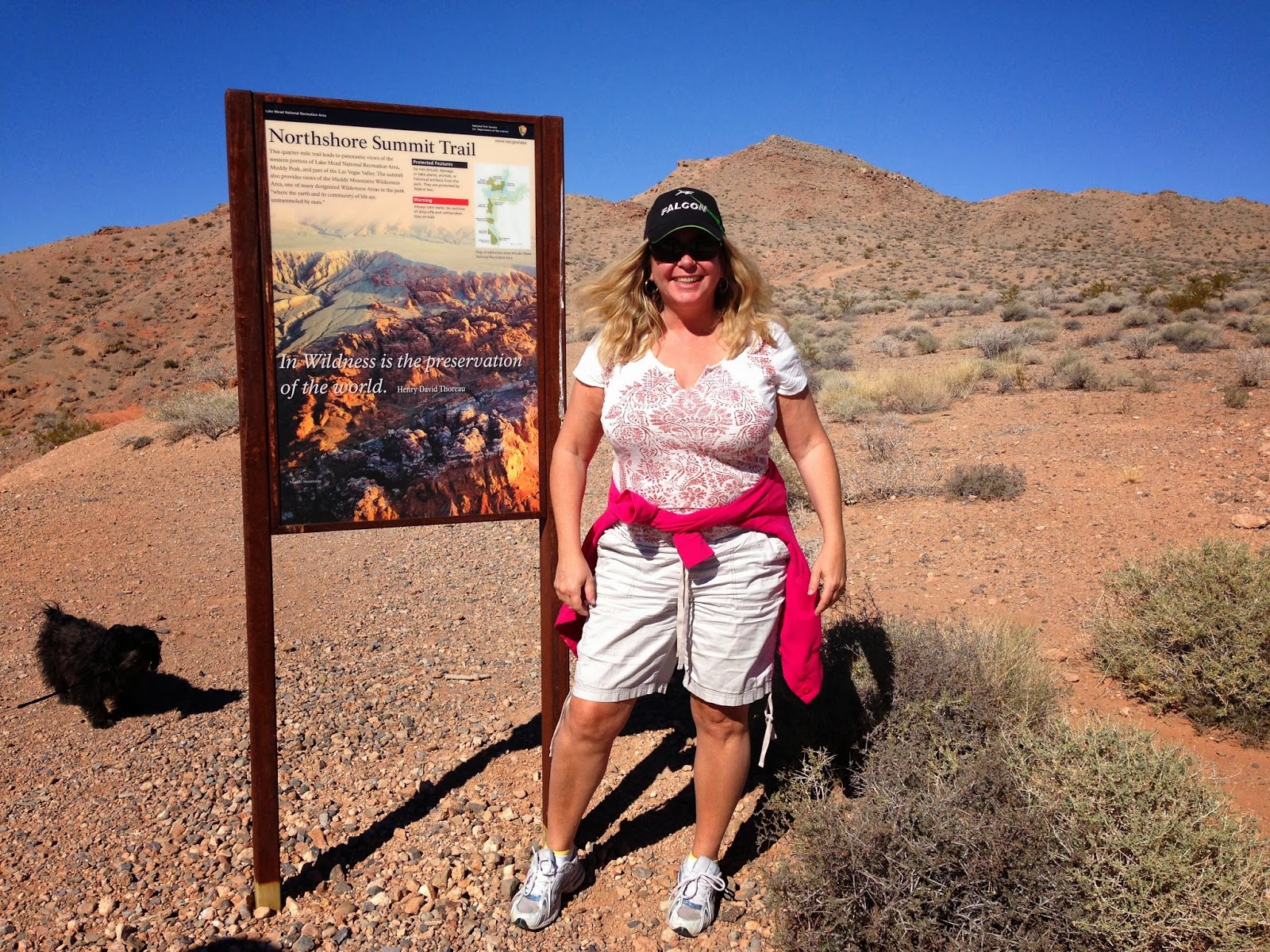
I look fairly hardy for a person who has only ever hiked twice and had never seen a desert in her life!


 A real-life oasis in the desert!
 
 
Thirty degrees colder during this hike in snow-capped mountains outside the desert.  Different stones, mountains and dreamscape altogether.


This caught my fancy in the Las Vegas airport.  It is the image of an airplane made of paper butterflies.


As seen from the air, coming and going, entering this land of fire and water.


I took this photo in the desert while daydreaming about the inspiration of shamans.  Unlike any other photo I took (and I took approximately 200 in the desert), this one reveals not only rainbow-like rays of sunshine but also a peculiar clear dome shape.  It might be the lens reflecting on my iphone.  But this photo struck me as very strange - made me think of UFOs some of which are clear and/or cloaked.  Further, when I downloaded all my photos and adjusted them for contrast and brightness, this was the only photo that my computer refused to permit any adjustments.  It says it is "read-only" and yet I never did anything to this photo.  Perhaps this photo represents the perfection of the beauty of the desert!


It was difficult for me to imagine ever having such an extraordinary view from my hotel window.  This photo doesn't begin to do justice to the beauty of the ring of mountains, the panoramic cityscapes (neon at night) and the huge skies.


Okay, sometimes dreams can be induced - with alcohol or even politics!


The desert, as I have learned, is beautiful for its geology, which has always been an interest of mine since I was a child.  I collect rocks.  I examine the bedrock along highways.  Here it is abstract art.  The desert is the beauty of colored stones, mountains, outcroppings, boulders, and dry vistas.


In the Nevada desert, I began to understand why anyone would go on a spiritual journey in this place.  It is enormous, silent, untouched by humans, wild, and the rocks begin to acquire a life of their own.  The desert is almost hallucinogenic.  I could see faces, animals, hieroglyphics, cities, oceans - anything - in the shapes of these strange rocks.  They spoke to me.  Above I see a speaking mouth!